Blog: WTF NFT?
Can digital scarcity create value in a copy-paste world?

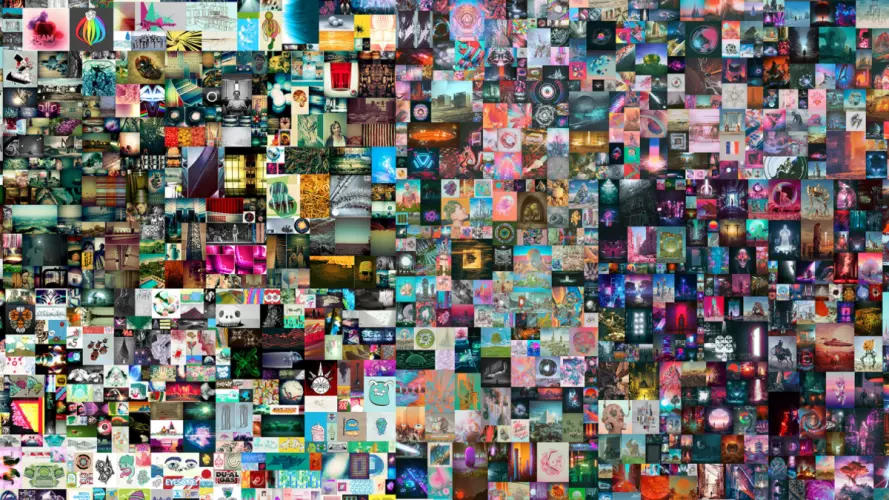
The picture above is a teeny-tiny version of 'EVERYDAYS: THE FIRST 5000 DAYS', a work by the digital artist "Beeple", and the subject of a heated bidding war at the auction house Christie's last month that eventually raised $69 million dollars. You might think "well, it's no rotting shark, but that's the modern art market", and you would be right, because Christie's has not sold the artwork itself, but a 'non-fungible token': an idea based on the blockchain technology behind Bitcoin. The notion is that the buyer of this "token" has obtained a permanent, decentralised digital record, acknowledging them as the owner of... well, not the artwork, but of the NFT that refers to the artwork. It's a little bit like paying just to buy a receipt. But on the blockchain.
NFTs have enjoyed quite the craze over the last month, with people selling tokens based on everything from historic tweets to Eminem performances. Of course, your million-dollar NFT could break tomorrow if you're not careful, as they rely on a simple link embedded within the 'token', and we know how fragile URLs can be. Also, an NFT comes with no claims to own the actual art, or to control its copyright or distribution. Indeed, a self-proclaimed "GlobalArtMuseum" tried auctioning off NFTs based on famous works of art on Twitter, claiming it would split the proceeds with the paintings' owners, like the Rijksmuseum.
There's been a spirited discussion on the Museums Computer Group mailing list as to whether NFTs are potentially useful for culture and heritage organisations: perhaps to track object provenance, perhaps as a fundraising mechanism allowing donors to "sponsor" a particular object or artwork. But I find the concept of Non-Fungible Tokens more interesting than their practical applications (which, at present, may be confined to money laundering).
In a world of digital reproduction, the claim to 'own', in the sense of 'have exclusive possession of and control over', a particular piece of art has never been more tenuous. The Louvre owns the Mona Lisa, but you can find a high-resolution image on Wikipedia and on a million posters, T-shirts and action figures. I own a selfie I take, but the second that I post it on Instagram, share it via WhatsApp, or upload it to cloud storage, I can no longer control who sees the file or what they do with it. Copyright law counts for little on the modern internet.
As makers of digital projects, we're acutely aware that to publish our work is to let it be copied, remixed and reinterpreted. If you think that value is based on scarcity, digital objects are worthless.
'Non-Fungible Tokens' offer the appearance of control. They reinvent scarcity in a world of Copy-Paste, promising a unique and permanent record linking a digital file to its 'owner'. People are certainly paying a lot for that (for now). It's also the exact opposite of what most digital humanities projects are trying to do. Most of us (and our funding bodies) want to make our data as open and reusable as possible. I think that if you can make a free copy of the Mona Lisa, that's priceless.
Until next time, may you receive millions of dollars in exchange for giving up little of actual value.
Sign up for one of our newsletters to receive stories like this one, plus event listings, funding opportunities, and digital humanities updates for the University of Oxford.