
The CHANGE project - The development of the monetary economy of ancient Anatolia, c. 630-30 BC.
Counting coins (and more) in ancient Anatolia
The CHANGE project is an interdisciplinary project in partnership with the University of Oxford, the British Museum and the Münzkabinett of the Staatliche Museen zu Berlin. The project is running from September 2020 to August 2026, and has compiled a dataset of hoards buried in Anatolia or containing Anatolian coins. With support from Senior Software Engineer and Research Collaborator Imran Asif, the project's datasets have been integrated into the ARCH project, and coinhoards.org.
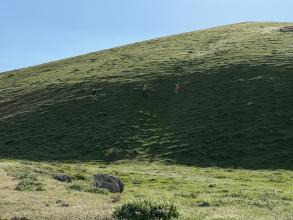
Andrew Meadows, Marcus Chin and Leah Lazar from the CHANGE project on top of the vast tumulus of Alyattes, founder of the Lydian empire, at Bin Tepe to the north of Sardis. It is at Sardis that the first coins were struck between 650 and 620 BCE.Photo: Frederic Wilner
The project maps the coin hoards across the region, and gathering the evidence around the development of the monetary economy of ancient Anatolia. The coins included in this project come from collections from all institutions in the partnership, and have been categorised and made digitally available using Linked Open Data.
An online database of inscriptions related to monetary activity, from texts inscribed in stone and metal, is being indexed and catalogued - the online database is available.
The CHANGE Project Site Finds Database maps coins found in archaeological excavations.
To view the database and more of the project visit the CHANGE project website: https://change.site.ox.ac.uk/home
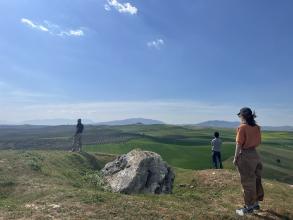
Andrew Meadows, Marcus Chin and Leah Lazar from the CHANGE project on top of the vast tumulus of Alyattes, founder of the Lydian empire, at Bin Tepe to the north of Sardis. It is at Sardis that the first coins were struck between 650 and 620 BCE.Photo: Frederic Wilner
CHANGE: The Development of the Monetary Economy of Ancient Anatolia c.630-30 BC has received funding from the European Research Council (ERC) under the European Union's Horizon 2020 research and innovation programme (Grant agreement no. 865680)